
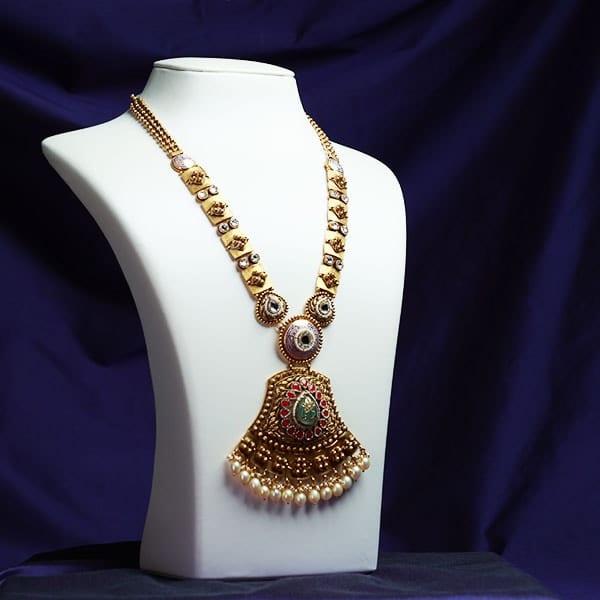
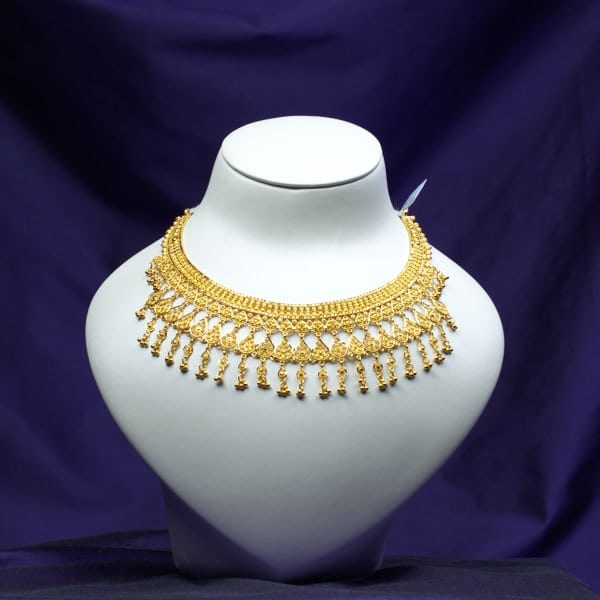
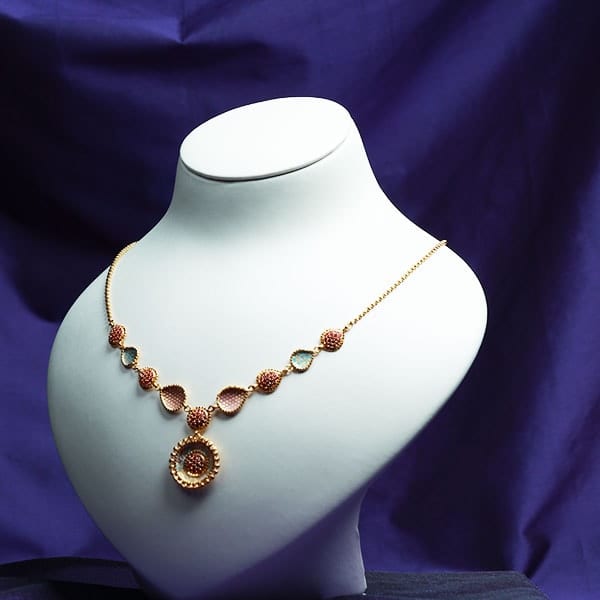
Gold jewellery sold in the UAE has to carry a small stamp that says how pure it is. On a 22-karat bangle it reads 916. On a diamond ring it is usually 750. Those three digits are the most useful thing on the piece, and they are easy to miss. Here is how to read them, who stands behind them, and what to ask for at the counter.
Fineness marks and karats
Gold purity is written two ways. Karat counts pure gold in twenty-fourths: 24-karat is gold with next to nothing else in it, 999 parts per thousand, and 22-karat is 22 parts gold to 2 parts other metal. Fineness says the same thing in parts per thousand, and that is the number the stamp uses.
The arithmetic is simple. 22 divided by 24 is 0.9167, so 22-karat gold is 916.7 parts per thousand, stamped as 916. The remaining 8.3 per cent is an alloy of copper, silver or zinc, added because pure gold is too soft to hold a clasp or a stone setting through daily wear. A 916 stamp and a 22K stamp mean exactly the same thing.
Dubai’s trade works mainly in four finenesses, with 14K a fifth you will see in some Western and Turkish work. Each has its job.
| Karat | Stamp | Pure gold | Typical use |
|---|---|---|---|
| 24K | 999 (999.9 for bullion) | 99.9% | Bars and coins. Too soft for daily wear. |
| 22K | 916 | 91.6% | Indian, Singaporean and Gulf bridal and traditional work. |
| 21K | 875 | 87.5% | Gulf standard for rings, chains, bracelets and bridal sets. |
| 18K | 750 | 75% | Diamond and gemstone settings, white and rose gold, Italian fine jewellery. |
| 14K | 585 | 58.5% | Everyday and heavy-wear pieces in Western and some Turkish work. |
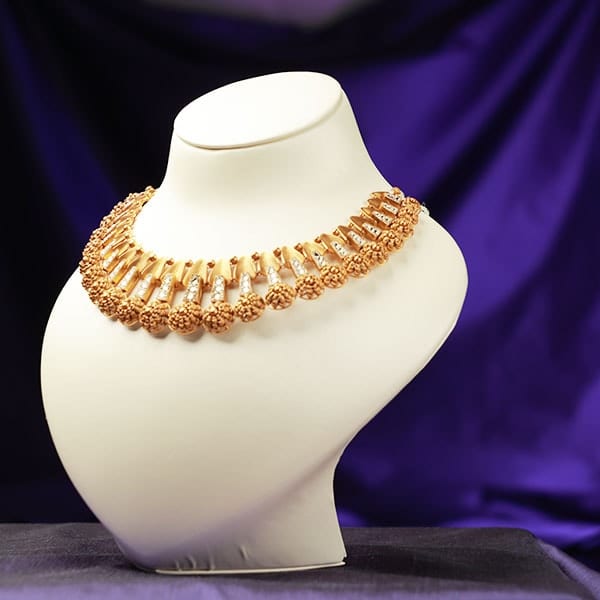
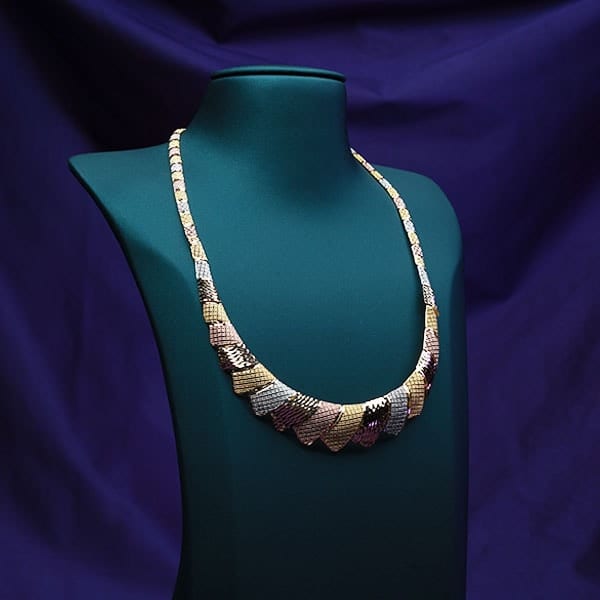
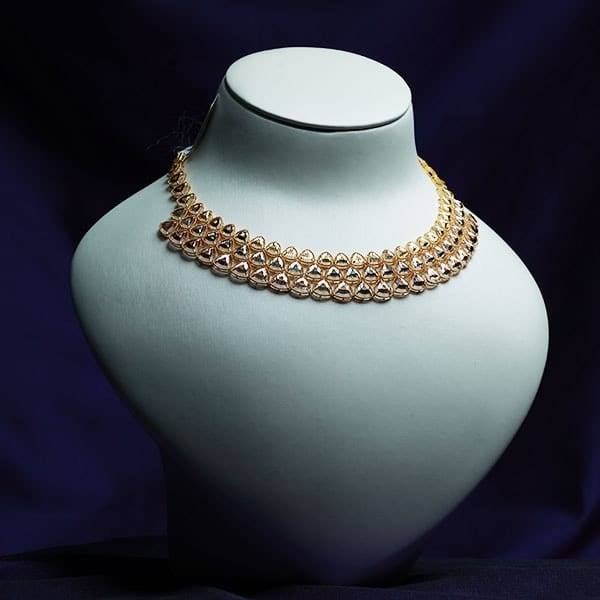
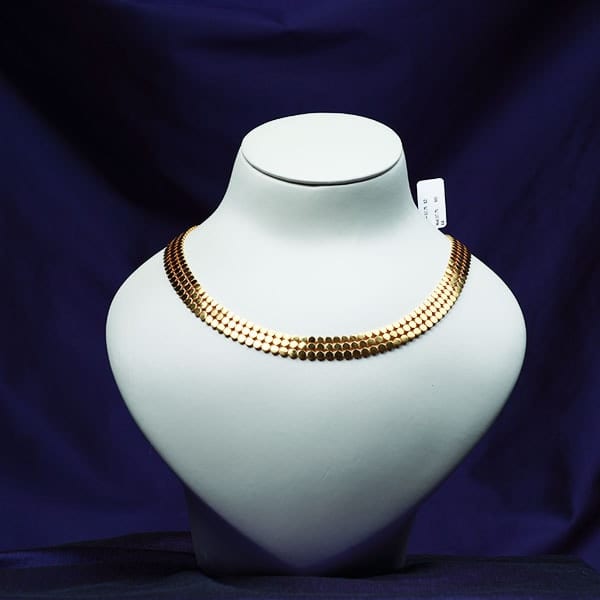
In our own shop the ladder runs the same way. Our Kolkata and Rajkot pieces are 22-karat work, the usual standard for those cities. Gulf designs are traditionally 21-karat, so on a Kuwait-style piece the stamp may read 875 rather than 916. Either way, read the stamp. Prices follow the same ladder: the gold-rate page shows the Dubai Jewellery Group suggested retail rate for 24K, 22K, 21K and 18K in dirhams per gram.
The law behind the stamp
Hallmarking in the UAE is a legal requirement, not a courtesy from the shop. Federal Law No. 11 of 2015, in force since May 2016, prohibits selling, offering or holding for sale any wrought gold article unless it is stamped with the official UAE hallmark or a recognised foreign hallmark. A Cabinet resolution issued in 2018 sets out which finenesses are legal.
A hallmark certifies more than purity. Under the Dubai regime it covers the fineness, the maker’s mark and a certification number, so a piece can be traced to its maker and its approver.
This is why “916 hallmarked” is the baseline in Deira rather than a special promise: every legitimate shop sells stamped gold. What separates shops is how openly they show you the stamp, the weight and the rate on the invoice. Our terms are on our promise page.
Dubai Central Laboratory checks it
Testing and inspection in Dubai is the job of the Dubai Central Laboratory, a department of Dubai Municipality with its main laboratory in Karama. It approves hallmarks, assays gold, calibrates shop scales to milligram accuracy and sends inspectors in unannounced. The laboratory has said it visits each retailer at least three times a year.
Under an agreement signed in January 2023 with the Dubai Gold and Jewellery Group, Dubai Municipality also takes samples at a dedicated point inside the Gold Souq, with test reports back in one working day rather than seven. In October 2025 it unveiled a self-service purity-testing kiosk that returns a result in under a minute, with the first unit planned for the Deira Gold Souk. A second opinion on any piece is a short walk from our Deira shop.
The UAE hallmark and India’s BIS mark
Many of our customers buy gold in both countries, and the two systems get confused. In India, hallmarking is run by the Bureau of Indian Standards. A BIS-hallmarked 22-karat piece carries the triangular BIS logo, the fineness 916 and, since 2021, a unique HUID code.
The UAE does not use the BIS logo. Here the stamp is the fineness number applied under the UAE hallmark regime, and the law also accepts a recognised foreign hallmark. The number itself does not change: 916 is 22-karat on either side of the Arabian Sea. What changes is who audits it. In Dubai that is Dubai Municipality through the Central Laboratory, not BIS.
Pieces under one gram
Not everything can take a stamp. The law exempts gold and platinum articles under one gram from the stamping requirement, so a tiny nose pin, an earring back or a small charm may carry no mark at all. That is legal, not a warning sign. For such pieces the invoice does the work: it should state karat and weight, and the shop should weigh the piece in front of you.
Where a piece is over the limit but too small to stamp, the law requires an identification card instead. Ask for it and keep it with the invoice.
How to check a stamp at our counter
Checking takes two minutes, and we would rather you did it than wondered later.
Ask for the loupe
Stamps are small and sit where they will not show when the piece is worn, so ask us to point to it. Under the loupe, read the number and look for the maker’s mark beside it.
Ask for the weight
Shop scales in Dubai are calibrated by the Dubai Central Laboratory to milligram accuracy. Have the piece weighed in front of you and note the gross and net gold weight. On a necklace with stones, the net weight is what the gold rate applies to.
Match the invoice
The invoice should itemise the net weight, the karat, the rate per gram, the making charge and the 5 per cent VAT. The price is the rate times the net weight, plus the making charge, plus VAT. If any line is missing, ask for it before you pay.
The same reading is the first thing we do when you bring old pieces in for gold exchange: stamp, weight, then the day’s rate.
Bring any gold you own, ours or anyone else’s, and we will read the stamp with you. Message us on WhatsApp, or visit a branch and ask for the loupe.